&&ot&ot ;html> Notes From Hairenik: A Blog About Life in Armenia

Notes From Hairenik
March 26, 2007
Armenian Prime Minister Dies

On March 25 Prime Minister Antranik Markarian passed away in his home at the age of 54. The cause of death was a heart attack, as reported by Channel 1Public Television. He was appointed to his position in 2000 by President Robert Kocharian, and was the longest serving Prime Minister since the inception of the Republic of Armenia.

In the 1970s he was one of a few dissidents who called for the establishment of an independent Armenian state free from Soviet rule and was subsequently jailed for his actions. He was a founding member of the Republican Party of Armenia in 1989, and he eventually rose to serve as the organization’s leader, up until his untimely death.

Prime Minister Markarian was perhaps best known characteristically for his mumbling and occasional incoherence whenever he spoke in front of the cameras, as his lips hardly seemed to move. He was also generally quiet when in the public eye. Although he did not really have the appearance that may be attributed to a died-in-the-wool statesman, he always had a dignified look about him, with an aura of professionalism that was not rivaled by many of his contemporaries. I would make jokes about this man with friends regarding where he should really be working or whatever, but now that he’s passed I must admit that he wasn’t a bad person. I have never heard any stories about his potentially perceived affluence and cunning as a businessman behind the scenes, and have not known anyone who has spoken negatively about him. According to his fellow party member and longtime friend President of the National Assembly Tigran Torosian, he never stalled to talk to ordinary people, whether they were morning street sweepers or old men trying to find a way to make a living in their villages. He always appeared to be a gentle, peaceful man who would never deliberately harm anyone. On the contrary, he was known to do whatever he could to help those that petitioned him. Critics have scrutinized his policies and failures to tackle one issue or another, but that is to be expected of any politician.

I cannot guess who will be chosen to serve in his place, not that it matters very much right now. Perhaps some ministers will be reshuffled in the process. But I think it is a great shame that a second Prime Minister died while in office in less than a 10-year time span. I think he was a good man who had much important work left undone. I don’t know what his legacy will be, but I would venture to guess it is having dutifully served his country to the best of his abilities, with honor and valor.

Labels:

March 24, 2007
Armenian mineral water should be OK

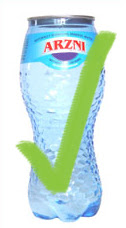
Well perhaps the Jermuk scare might not be so grave as it may have seemed, according to my mother-in-law, who studied chemistry at an early age and worked at one of the main chemical factories in Vanadzor during the Soviet era. She believes that drinking Jermuk or any other carbonated mineral water such as Bjni or even Arzni, which had anywhere between half to a quarter of the anions and cations contained in Jermuk, including calcium according to its label, is not detrimental. That is, Arzni used to have less mineral contents than Jermuk Group water until the latter apparently changed its label to suggest otherwise. Two different bottles of Jermuk Group water that I had purchased a few weeks ago had different labels showing contradicting mineral content information. I remember comparing one of them side by side with an Arzni bottle, and there were huge differences in mineral counts.

Anyway, she makes the point that for decades, especially during Soviet times, people have been taking mineral baths at spas in places where mineral springs exist, and no one was ever reported of enduring arsenic poisoning. Another thing to remember is that lots of Jermuk is exported to Russia, and it is served in the Kremlin, so in that case you can imagine that President Vladimir Putin is probably consuming it from time to time. Apparently according to her, as she is currently studying agriculture at one of the state universities in Yerevan and is taking courses in food inspection, Russian drug and food testing is very strict, and nothing found to be considered very harmful, including supposedly potentially fatal levels of arsenic, would ever be imported and sold on the market, let alone be consumed by government officials. She told me to keep drinking mineral water and not be afraid of it being dangerous to my health. I really have no reason to doubt her as she has never been wrong before in terms of what things to eat for specific purposes—her administering of various things like herbal teas and such for ailments have never had adverse results on my health nor have they not been effective to some extent. She’s fairly well read about such matters so basically I trust what she says. And according to Panorama.am in an article published on March 13, the American Food and Drug Administration (FDA) only tested one bottle of Jermuk to have been found having 500 micrograms of arsenic, which according to a Jermuk Group spokesperson was counterfeit.

I’ve spoken to several people and they seem to concur what I initially deduced a couple of weeks ago, that the sudden ban of Jermuk was politically motivated. As a result of the FDA’s warnings both Canada and Hong Kong have apparently stopped imports of Armenian mineral water. However, let’s not forget that in an article reported by ArmeniaLiberty.org on March 13 a United States Department of Agriculture (USDA) employee running a project here named Sean Carmody admitted that “You have to drink a lot of mineral water per day to really have any effect. You have to drink around 20 liters of water a day.” Then he said regarding the scare that “‘It’s either a testing issue or a labeling issue,’ he added, demonstratively sipping Jermuk on the sidelines of a roundtable discussion on Armenia’s national food safety strategy.”

So for now, since I really no longer have serious doubts about the safety of Armenian mineral water, I will resume drinking it once again, albeit in more limited quantities. Arzni is generally an excellent alternative to Jermuk I have found, incidentally. Mind you I never bothered to buy one of those chemistry sets they sell at the end of the Vernisage to perform my own tests for arsenic levels or hire someone qualified to do so, but I think people should be OK when drinking mineral water with meals or afterwards for better digestion. Drinking Jermuk has never done me wrong at least.

Labels: ,

March 19, 2007
It’s Started
Yesterday I attended the third assembly organized by a group which calls itself “It’s Started.” Most of the organizers with the exception of one person I met were no more than 25 years of age. The purpose of the group is to spread awareness amongst Armenian youth about what is going on around them, and what it means to be a citizen of Armenia. They do not consider themselves as representing any kind of movement. Basically I stood by and observed along with another friend of mine to see what would happen.

The group essentially gets the word out about the happenings by posting flyers on lampposts and walls, and also by affixing announcements to cars—I saw one attached to a window of a rabizmobile—the Lada 2107—parked across from my apartment building on Nalbandyan Street. In an era when the most important things that seem to interest youth are the latest innovations in mobile phone technology, fast cars, and counterfeit designer sunglasses, the moment is right to “wake up” late teenagers and twentysomethings and influence them to actually pay attention to their society and what it does or doesn’t mean to them.

The group and its followers meet at the Komitas Statue near the Opera House, a significant meeting place since it is arguably the only monument to a revolutionary-in-thought mover and shaker in the vicinity. Two weeks ago alarm clocks were hung from a string that was tied between thin lampposts surrounding the statue, forming a circle. The theme of the gathering was “Wake Up,” an effort to provoke young people to think and act in ways that would be more productive to their own lives as well as those of others in their environment. The theme of yesterday’s event however was whether to read or not read Armenia’s newspapers. Hundreds were made available to pass out to people who bothered to show up as well as to passers-by. The first thing I saw as I approached the park were newspapers hanging from clothespins affixed to a string circling the statue and people wearing hats made out of newspapers. Every newspaper was stamped with “It’s Started” in large, red letters printed in Armenian. The crowd broke up into groups of five—each group stood on a corner of Freedom Square/Place de France, and another group stood on the circumference of the rotary in the middle. Everyone held newspapers in front of them, while others held up banners affixed to wooden poles reading, “Should We Read Them?” in Armenian. After about 15 minutes, the traffic cop sitting in his Lada told everyone to get off the rotary as they were interfering with the flow of traffic—nearly all the minibus drivers who happened to drive by stopped to receive newspapers from the organizers and pass them on to their passengers. The crowds then returned to the statue and were then told to cut out the articles that they liked the most from each newspaper they held, then affix them to a bulletin board that was provided. After a few minutes I walked passed the board to see that each article that was chosen had something to do with youth or youth-orientated interests. Some had thought-provoking topics, while others were somewhat blasé—horoscopes and the like. Only a couple of articles that were chosen dealt with politics, which were defaced with smartass comments that one or two clever people wrote. At no time did any of the organizers suggest that the newspapers were or were not worth reading. The exercise was to let those who attended decide of their own accord.

“It’s Started” claims to not have any political motivations or allegiance to any political party or group, although this is somewhat hard to believe. But what impressed me was the fact that people took active interest in what was going on—at one point a 12-year-old stopped to ask me what all the fuss was about. Even some elder folk bothered to show up, either to criticize or encourage—one woman possibly in her 80s started addressing everyone with a bullhorn provided for her.

The group plans to meet next week, again at the same place and the same time: 1:00 pm. The theme of the meeting will be the “Southern Boulevard,” as opposed to the monstrous, unwieldy Northern Boulevard that is no where even close to being completed in the next year or two by the looks of things. It will be interesting to see whether the group continues to attract more youth at every meeting, but apparently the number of attendees has already doubled since the first gathering—about 200 people were in attendance yesterday. It’s curious to see what will take place in the weeks fast approaching national assembly election day, which is May 12.

Labels:

March 12, 2007
No more Jermuk!

Anyone who knows me realizes that I drink mass quantities of Jermuk, which is a lightly carbonated mineral water bottled in a town of the same name in southern Armenia. At one time I was averaging around 1 liter per day, although in the last couple of months I hardly drank any because I was out of the country. And in the last two weeks I purchased only four 1.5 liter bottles, a low count for my household.

But it seems my Jermuk drinking days are over, or at least suspended until further notice. The other day I received an official U.S. Embassy Yerevan Warden Message about the FDA finding high quantities of arsenic in the stuff—about 500 micrograms per liter. I figured this was some kind of warning to the Armenian government to get its act together about governmental corruption and ensuring free and fair elections, since effectively Jermuk bottling companies could now suffer from dangerously high profit loses on export sales as well as sales within Armenia, thereby hurting the economy to a small extent just by issuing one press release. Yet, an article posted on ArmeniaLiberty.org proved me wrong.

But according to FDA, testing of Jermuk products found that they contain between 500 and 600 micrograms of arsenic per liter. “FDA’s standard of quality bottled water allows no more than 10 micrograms per liter,” the agency said. It argued that extended exposure to the poisonous metal could lead to cancer and death, but added that so far there have been no recorded cases of illnesses caused by Jermuk.

The Armenian standards, set by the National Institute of Standards, allow for up to 700 micrograms of arsenic in one liter of mineral water. But the institute director, Yerem Chakhoyan, acknowledged that Jermuk should be regularly drunk only by individuals suffering some stomach and intestinal diseases.


Not good news. I really love the stuff, I think it has a great taste and it always cures an upset stomach, not to mention it’s generally good for digestion. Now the hope is that other competitive carbonated mineral waters bottled in Armenia, such as Arzni and Bjni, will be found to have little to no arsenic in them. Arzni is a bit cheaper and tastes just as nice, so here’s hoping that my absolute switch will prove to be a very wise choice. Otherwise I’ll have to find a way of carbonating filtered tap water.

Read the full article about the dangers of Jermuk here.

Labels: ,

March 6, 2007
Some remarkable things to note
I’ve finally had the chance to write a new entry after a week of recovering from a flu-like illness inherited from my mother via my wife, shaking off jetlag, and getting caught up with work, not to mention visiting with friends and family. Generally I’ve found that not much has changed to the naked eye, at least around Yerevan. There is still a gaping wide pit in the back of my building, which has been there for at least one year now without any indications that a foundation will be laid soon for a new high-rise cement-framed apartment building to match the other few dozen or so structures that are still going up. There are still only two completed buildings on the Northern Boulevard, as none of the ones near the Abovyan Street side have come even close to finishing, and it doesn’t look like much progress was made the eight or so weeks I was away. Funny thing is that the project was supposed to have been completed this year. So nothing new to report regarding the slow pace of construction and subsequent mini-sand storms that form slapping the faces of pedestrians.

One thing that is noticeable is the number of political party local offices sprouting about, namely registration chapters of the Republican as well as Prosperous Armenia organizations. The Republican party is headed by Prime Minister Antranik Markarian (unofficially by Defense Minister Serge Sargsian who only joined the party last year), while Prosperous Armenia is led by everyone’s favorite, friendly oligarch Gagik Tsarukian, otherwise affectionately known as Dodi Gago. This party already claims to have over 380,000 members, just in time for the parliament elections coming up in May, despite the fact that it has barely been in existence for one year. The way they attract members is not so ingenious—roam about the regions and hand out a sack of flour or potatoes to each person they see in exchange for a signature on a form that claims his or her party membership. As a result Dodi Gago now has a cult-like following by ordinary citizens who are not exactly wealthy but are charmed by the generosity. What they fail to understand is that they are selling themselves and most definitely their votes to Prosperous Armenia, which is already predicted to take at least half the available parliament seats. But the people don’t seem to care that they are basically discarding their own clear, conscious decision to choose the candidate of their liking—they will naturally feel obliged to vote for Prosperous Armenia even if they do feel inclined to elect another candidate. What dirty tricks these Armenian political parties play.

I parked my car in the same place I’ve been leaving it for about one year now the entire time I haven’t driven it—perhaps 10 weeks altogether—located a stone’s throw away from where I live. After filling up a few liters of gasoline in the tank—just in case someone siphoned off the fuel while I was away—I was able to start the old Niva up without much difficulty. It took me a while however to realize my car was actually broken into. When I inserted the key into the door lock I noticed it was open already, and I immediately figured it was an oversight on my part, although unlikely because I usually check the doors twice before I go away for an extended period of time. Then finally I noticed after sitting in the car for 15 minutes or so while it was figuring out how to run again that the driver’s side vent window clamp lock was gone. The thing is about an inch wide and just under two inches long made from some kind of aluminum alloy which to me seemed non-malleable. In fact the person who sold me the set of two about 20 months ago assured me that it would be extremely difficult to tamper with them, but apparently not impossible judging from my case. The strange thing is that nothing was taken from my car from what I could see—not the $50 pair of sunglasses or the radio worth about the same, not the few tools I have, not the camera tripod in the trunk, nor even any parts from the car—nothing. Which means the person who broke into the car just did so for the challenge, or he is very stupid for not taking anything. Who knows? I am done trying to figure out peoples’ mentalities here for sure.

Another interesting thing—there no longer appears to be policemen on the sides of the road flagging people to pull over in order to extort bribes. Although this was told to me by my mother-in-law and indeed was verified as I drove to Vanadzor last weekend, I cannot yet find evidence of the passage of the law in place that effectively abolishes the placement of police on regional borders or in arbitrary places. Now law violators will be stopped by police patrol cars, which I have already witnessed in Yerevan, and they have supposedly no chance of paying the cops off since there are tiny devices placed somewhere in their uniforms recording motorists trying to offer a bribe, whereby they are then penalized. The ironic thing is that a new similar business aimed at duping the naive will replace the other whenever necessary. As you enter Vanadzor from Spitak, on the adjacent spot where the recently demolished police border station was now lies a tiny casino.

One more law recently passed—the right to dual-citizenship. Although I have yet to find out the juicy details, apparently once you become a dual-citizen you can effectively vote during the elections no matter where you live in the world—just in time for next year’s presidential elections. But from what I understand the catch is that you have to actually be present in Armenia to cast your vote rather than by an absentee ballot. If that is what it takes to activate the Armenian Diaspora to work in giant strides towards nation-building, then so be it, but frankly I don’t know if this law will make much difference regarding that. One commentary I read yesterday in the Armenian Weekly effectively legitimizing the concept that the Diaspora should continue to flourish in full force, especially after the passage of this law, is not encouraging. Here’s hoping I am wrong.

A sad note to report is the self-immolation that took place less than a week ago on Republic Square in front of the Government Building. Apparently a man from a village who was so desperate because of his poor financial situation chose the ultimate form of protest to demonstrate against the government’s apathy towards the impoverished, especially for those who lost their life savings overnight with the hyper-inflation that occurred in the early 1990s as the Soviet Union was breaking apart. Basically he demanded an interest-free loan from the government which was of course refused. But the fact that people are going to such great lengths to get their point across is scary and should be a wake-up call to the carelessly corrupt authorities. Hopefully something will change, but I fear that people will regard the man as simply having been crazy and move on without thinking about the man’s personal sacrifice for his convictions as a human being who deserves better for himself and his family.

Labels: ,