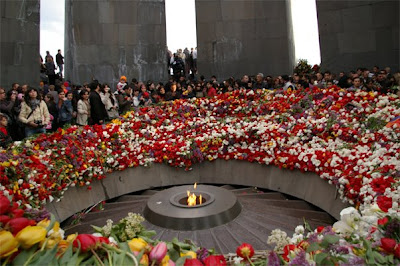
The "road map" which was signed between Turkey and Armenia on April 23 has been divulged, the Turkish SABAH newspaper reported. The "road map" comprises 5 paragraphs:
Armenia must accept the Kars agreement which was signed between Turkey and former USSR in 1921.
A joint commission of historians must be formed to investigate Armenians "genocide" claims and the third country can join the commission.
The Armenia-Turkey borders will be open and relevant documents will be signed to launch trade relations.
Direct diplomatic relations will be established when Armenia and Turkey accredit their ambassadors to Georgia to Ankara and Yerevan.
Parliament will directly discuss the issues of the "road map" which must be confirmed by any legislative body.
According to SABAH newspaper, although the document does not comprise the Karabakh issue, the two countries' approaching will take place simultaneously with ways of the conflict settlement.
The Soviet-Turkish borders established as a result of the wars of Sept./1920 – March/1921 were adjusted and confirmed by the treaty of Kars signed by the representatives of Turkey and the four Soviet republics of Russian federation, Armenia, Georgia and Azerbaijan on October 13, 1921. According to the provisions of the treaty of Kars, the treaties of Sevres and Alexandropol were denounced and both the Turkish and Armenian sides agreed to forgive each other all the “military crimes and mistakes” committed by their representatives during all the wars, conflicts and ethnic cleansings of 1915-1920. The treaty of Kars left Turkey with most of the territories conquered during the Turkish-Armenian war and the Soviet-Turkish war against Georgia. Turkey re-gained almost all the territories lost to the Russian Empire during Russo-Turkish war of 1[8]78, except northern half of Achara, with the towns of Artvin, Ardahan, Olty, Sarykamysh, Kaghyznman and Kars. Turkey was also granted the large part of the former Yerevan province to the south of Araxi river with the town of Ighdyr and the mountain of Ararat (the national symbol of Armenia). The latter territory had never been a part of Turkey, except a short period between 1724 and 1735. In turn, Turkey returned the area of Alexandropol to Soviet Armenia and dropped all the claims to Sharur-Naxcivan-Ordubad area under the condition that the area is not to be incorporated into Armenia but becomes a Muslim-dominated autonomy within Azerbaijani SSR.By agreeing to recognize the current border (whether informally or formally is not exactly clear) Serge Sarkisian can now be legitimally considered as working against the interests of the entire Armenian nation by not securing its collective consent. If this border is the final accepted one, it will mean the virtual death of the Armenian cause, including the demand of Turkey's recognition for having committed genocide, and any hopes of ever reclaiming the historical Armenian lands will be completely lost.
The above territorial losses were and still are regarded by many Armenians as a national catastrophe, and the borders as defined by the treaty of Kars, are far from been fair from the point of view of Armenian nationalists many of whom still consider the treaty of Sevres as the basis for the resolution of Turkish-Armenian conflict.
Labels: Armenian Genocide, Politics
A New York Times article that appeared on April 23 confirmed that a framework, defined as a “roadmap,” had been agreed upon by Armenia and Turkey assuring that continuing, mutually beneficial relations between them were forthcoming. However, the Turkish side insisted that the Armenian-Turkish border would remain closed.
“The two parties have achieved tangible progress and mutual understanding in this process and they have agreed on a comprehensive framework for the normalization of their bilateral relations in a mutually satisfactory manner,” a joint statement read.
As of April 23 both the Turkish and Armenian foreign ministries refused to comment on the details of the agreement.
Labels: Politics


Labels: Armenian Genocide
Labels: Food and Drink, Personal Experiences
At early evening on Sunday I was on my way to Hrazdan in my blue Niva with my friend Jason Sohigian, who was visiting his wife’s family for two weeks. He wanted to take some shots of the thermo power plant there, which makes electricity from natural gas, as he was doing research for a paper he needs to write -- he’s studying Environmental Management part-time at Harvard. On the way there we suddenly heard something dragging along the pavement. We pulled over to the side of the road and saw to our dismay that the muffler had dropped, but not completely. A piece of rubber which connects the tail pipe to the undercarriage finally wore out, and it seemed that the muffler itself was separating from the exhaust pipe judging from the 45 degree angle at which it was tilted downward. Conveniently enough—I won’t say miraculously as pieces of junk are always strewn along the roadside, sometimes hidden under broken asphalt or semi-decayed leaves in our case—we found a long, flat fastening wire which served perfectly to attach the tail pipe to the undercarriage, as we found a hole through which the wire could be passed and looped around the pipe. Just to be extra safe we also tied an old motor belt that had also been discarded. Jason managed to do all this work within a five-minute time span and we were off again. It was still light out so we were able to take about 50 or so shots between us with our cameras.
So Monday morning I went down to the garage where I always take my car which is situated beside the circus, run by Karen Hovakimyan and his brothers. All of them are great guys and they’ve been helping me with auto repairs for nearly four years now. They even saved me thousands of dollars on a Niva I was interested in buying which they found had been in a serious automobile accident just by inspecting the chassis. It was obvious that the muffler had to be welded to the exhaust pipe. I purchased the rubber part needed to hold the thing in place while they broke off the muffler as it was already hanging by a thread at that point and put it in the Niva’s rear cargo space.
Karen’s brother Ernest, who sold me his Niva exactly one year ago, recommended a guy named Lyova who specialized in installing exhaust systems in Arabkir. His garage, located a couple blocks east of Gomidas Avenue on Gulbenkian Street, was practically suspended over the gorge there. When I asked him how he was he unexpectedly told me that he hadn’t been feeling well, and the doctors had not been able to find anything during their examinations. Even an endoscopic probe found nothing. But his spirits were high enough that he could figure out what needed to be done with the car. One look at the muffler convinced him that it needed to be replaced. A hole smaller than a dime had formed on top and there were some rust spots in several places, especially on the underside. It was typical of factory-manufactured parts he told me and said a replacement part which could be purchased at an official Lada parts store wouldn’t last a couple of years before it rotted out as well. I’ll have to say that I was relieved when he told me that he makes his own homemade mufflers. He showed me something that he said was made of solid metal, like iron supposedly, which had been spray-painted silver. He guaranteed that it would last me a minimum of three years, and it would survive probably five years or even more. He told me that his muffler and the one I could purchase from the store were priced nearly the same but the Russian-made part would show signs of wear only after four weeks. It took about one minute for him to convince me to weld it on so I could get out of there. The last thing I wanted to do was call a taxi and convince the driver to take me to the Lada auto parts store at the other end of Gomidas Avenue to bring back a muffler. That would have been a hard sell, and then there would be the added aggravation of finding out they were all out of mufflers because of a region-wide “deficit,” which transpires for certain parts occasionally. I tapped lightly on his muffler and it seemed really solid, while the old muffler made a tinny sound when I rapped on it, like an empty coffee can. When I asked him how much he wanted he told me that the muffler would cost 22,000 dram, or about $60 with today’s exchange rate, while labor was another 3,000.
I knew there was an HSBC bank about a five-minute walk down the street at the intersection with Gomidas, so I headed towards there. After I withdrew some cash I decided to walk up a half block to a place that made excellent khachaburi—a puff-pastry most often filled with cheese or other things like mushrooms or even beans, depending on where you go. As I walked up the street I noticed a store which sold a vast selection of Armenian wines, which I had seen while driving by many times but I never had the opportunity to visit. I figured my chance finally came so I went inside to see what they had. It was an adequately sized store with bottles of wines everywhere, and also some Armenian liquors displayed along the walls. The woman asked me what kind of wine I was looking for, and I told her that I usually drink dry wine, mostly Areni. Then she asked whether I wanted to drink something better than ordinary Areni. This question intrigued me because I wasn’t aware that other dry Armenian wines could be had. She suggested that I try a wine called Karmin, made by a tiny, unobtrusive winery called Vozkevaz. I’ve never been in any store in Yerevan that offered wine tasting, so by that point I was anticipating something divine, yet skeptical that what she was about to serve wasn’t going to compare with the usual wines from Maran Winery which I swear by as being the best bottled offerings in the country. She poured a few drops into a wine glass, which I lifted to my nose, then I smelled the bouquet just to make sure it was reminiscent of wine and sipped. The wine exploded in my mouth. It was an intense, complex wine high in tannins, not fruity although lively as Areni often is. It reminded me of a good French wine, like Côtes Du Rhône, maybe not exactly on par, but it was very good. And priced at only 1900 dram a bottle! Then she offered me to try Muscat, which is a dessert wine, light brown in color, and something that didn’t impress me the previous time I tried it. The Muscat was in a thin, transparent liqueur bottle, which seemed odd as it’s usually found in ordinary wine bottles. When I muttered that I don’t like Muscat she retorted that I didn’t have to like it but I should try it nevertheless. Muscat is considered semi-sweet wine, but this offering had a consistency of olive oil; it was smooth, gliding down the back of my throat, yet it wasn’t terribly sugary, but delicate. That Muscat was also made by Vozkevaz, which was a sign that I was about to switch favorite wineries. I told her I would be back.
I finally made it to the khachaburi spot and bought something called samsa, which was a turnover filled with pulled chicken, finely chopped cilantro and onions. After the wine it made a tasty snack. By the time I made it back to Lyova’s garage nearly 30 minutes later he had already finished. The car indeed sounds a decibel or two quieter than it did before the other muffler gave out. He revealed to me the magic ingredient that made his muffler so special but I had no idea what he was talking about since he was using the Russian word. Even if he happened to know the Armenian word for the mystery metal used to do the muffling and whatever else mufflers do I most likely wouldn’t have understood. But at least I know who the go-to man is whenever I need soldering work done on the car. Hopefully that won’t be necessary, but he told me he also does some limited electrical work on “Soviet” cars so undoubtedly he will be of assistance to me in the future since these jalopies always seem to have glitches in the system. Despite the inconvenience of having a bum muffler it turned out to be an efficient, easy-going day, which is always a lovely happenstance in this nutty town full of neurotics.
More about the wine in my next post.
Labels: Food and Drink, Personal Experiences
Labels: Fashion, Personal Experiences, Thoughts and Musings
On the one-year anniversary of President Serge Sarkisian’s taking office several protesters hanging around the top of the Northern Boulevard were attacked or arrested during the last couple of days. Seems that the government has had enough of people loitering, singing patriotic songs or whatever else they happen to be doing all day long. Nearby restaurant owners are complaining, not that it matters much since it’s not exactly a bustling area to begin with. RFE/RL published an article with more information about journalists being beaten up, random people being arrested, and so forth.
This news is no longer shocking; rather describes a routine, expected way of life. What is shocking, however, is this continuous effort to show support for Levon Ter-Petrossian when he no longer cares about the presidency. I’m not sure he cares about his candidacy in the upcoming Yerevan mayoral elections. He doesn’t even hold political rallies any more, which is strange considering that the elections are about seven weeks away. Quite honestly, I can no longer really take his supporters seriously, with few exceptions like for instance former Prime Minister Alexander Arzoumanyan who seems to have a raging fire in his belly and won’t withstand nonsensical proceedings held against him in the courtroom. There’s no point in risking being arrested or beaten when the leader you are apparently supporting is oblivious or apathetic to the protests going on in the name of his cause. He seems to have had his fun and has crawled back into his stale shell in his mansion above the Hrazdan gorge.
I don’t believe that Armenians really want things to be different from the status quo. They are clearly divided on the issue of regime change. If there was such a drive to oust the government it would have happened last year. It didn’t happen because people were too shook up about the events of March 1 or they didn’t have the spirit to continue. But if you want change bad enough, you have to fight for it, you have to “struggle until the end” as the opposition was so vociferously charging back then. I’m no longer convinced that the Armenian people indeed want change. So long as they can buy their cars, mobile phones and bread-- not to mention manage to stay out of trouble-- they’re happy. Maybe that’s enough. It seems that way to me at least.
Labels: Politics